








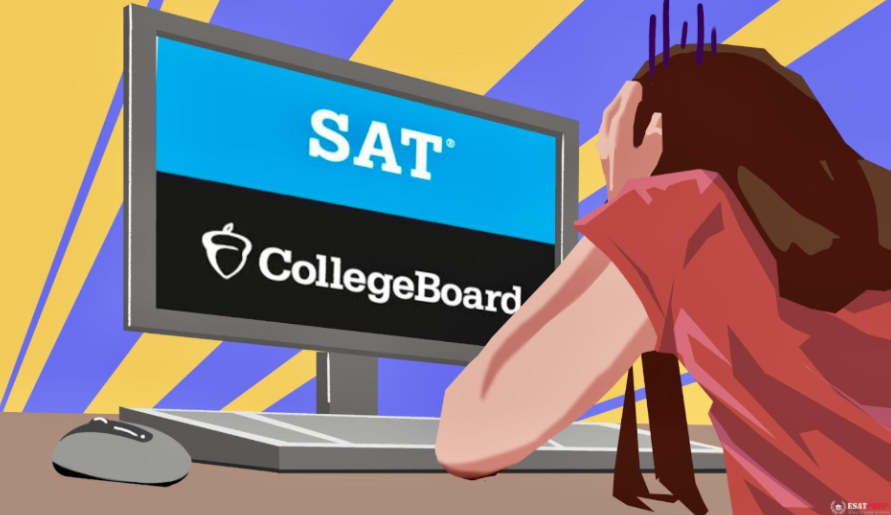
Every year, students put their noses to the grindstone, laboring away at studying for the Scholastic Aptitude Test—more commonly known as SAT. This test, administered by College Board to over 2 million students per year, aims to provide colleges across America with a simple metric which quantifies a student as an academic success story or as an unqualified applicant overall.
Over the years since its creation 1926, the SAT’s importance has shifted significantly—growing from a humble test of intelligence to practically becoming the benchmark test for a student’s breadth of knowledge acquired from their many years of schooling. This has radically changed students’ philosophies regarding the character of the test in general—some students now consider the test as an ultimate predictor of their future success in fostering a fruitful life. These students tend to adopt and go through a variety of intensive training methods and programs, in the hopes of just raising their scores 10 points above the crowd.
Individuals such as these often begin taking practice exams for the SAT years in advance. The PSAT (practice SAT) is generally first offered to students in 9th grade, two whole years before the actual SAT begins. Despite this long time gap, over a million underclassmen still take the official practice test, showing how important the actual test is to them. Juniors also take the PSAT/NMSQT in the fall, with that exam having over 3 million test takers and offering lucrative college scholarships to high performing students. Through these practice exams, these students aim to not only simulate their actual SAT performance, but to find out exactly what their weaknesses are. Through this, long-term study plans are developed: preparing for months with daily problem sets, weekly practice tests, and periodic score evaluations. The cumulative effect can be mentally draining: hours of dense reading passages, abstract math reasoning, and relentless self-correction. Yet for many students, this disciplined—and occasionally grueling—routine becomes the pathway to mastering the exam’s patterns and constraints. Pupils isolate specific question types—such as algebraic manipulation, data analysis, or rhetorical strategy—and work through dozens of nearly identical problems in succession. The goal is not simply to understand the concept but to internalize the pattern so thoroughly that recognition becomes almost automatic, a necessary condition for a high performance on the real SAT, where students are given less than a minute to work through each difficult problem.
However, others now contend that the SAT has ultimately lost its value as of late. Certain colleges and universities are beginning to reject the idea of one specific examination as a marker for a student’s ability, taking the position that a student cannot be quantified by a number, but rather should be evaluated on a basis of their overall personality, passion, and projects. In addition to this, many students are simply unwilling to undergo the arduous process of preparing for the rigorous examination; more students now find the value of the SAT in the eyes of various universities to be diminished to the point where it doesn’t even matter if they take the test or not. At Cal High, this sentiment has grown significantly—a trend is occurring wherein less students are taking the test each year compared to the last. When asked whether he was taking the SAT or not this year, Cal High junior Alan Flores stated, “No, I’m not. I mean, colleges aren’t really looking for high SAT scores anymore, and I’m already busy enough with my other work. Why add more stress to my life, you know?”
Ultimately, one’s background may determine whether the SAT is seen as important or not. Having just taken my own first SAT in this month’s administration of the test, I noticed a variety of trends in the students who showed up on a Saturday morning to take the test. These students generally performed highly on past SAT tests they had taken beforehand, and came from economically and academically well-off high schools. It may be the case, therefore, that the SAT is seen as more important there than within socioeconomically disadvantaged student bodies. Thus, the question must be asked of whether taking the SAT is truly beneficial to students from disadvantaged backgrounds—if rigorous study is encouraged within these backgrounds, it may result in the success seen in communities whose students generally perform high on this exam.
This possibility is of further interest to students looking to advance themselves given that a variety of elite universities are ending test-optional policies. This comes largely as a result of new student classes—enrolled under test-optional policies—struggling in foundational topics covered by the SAT, which can lead to these universities’ reputations being tarnished significantly. Ultimately, whether you believe in the SAT’s importance as of now or not, the test’s importance may ultimately rise in the years to come.