






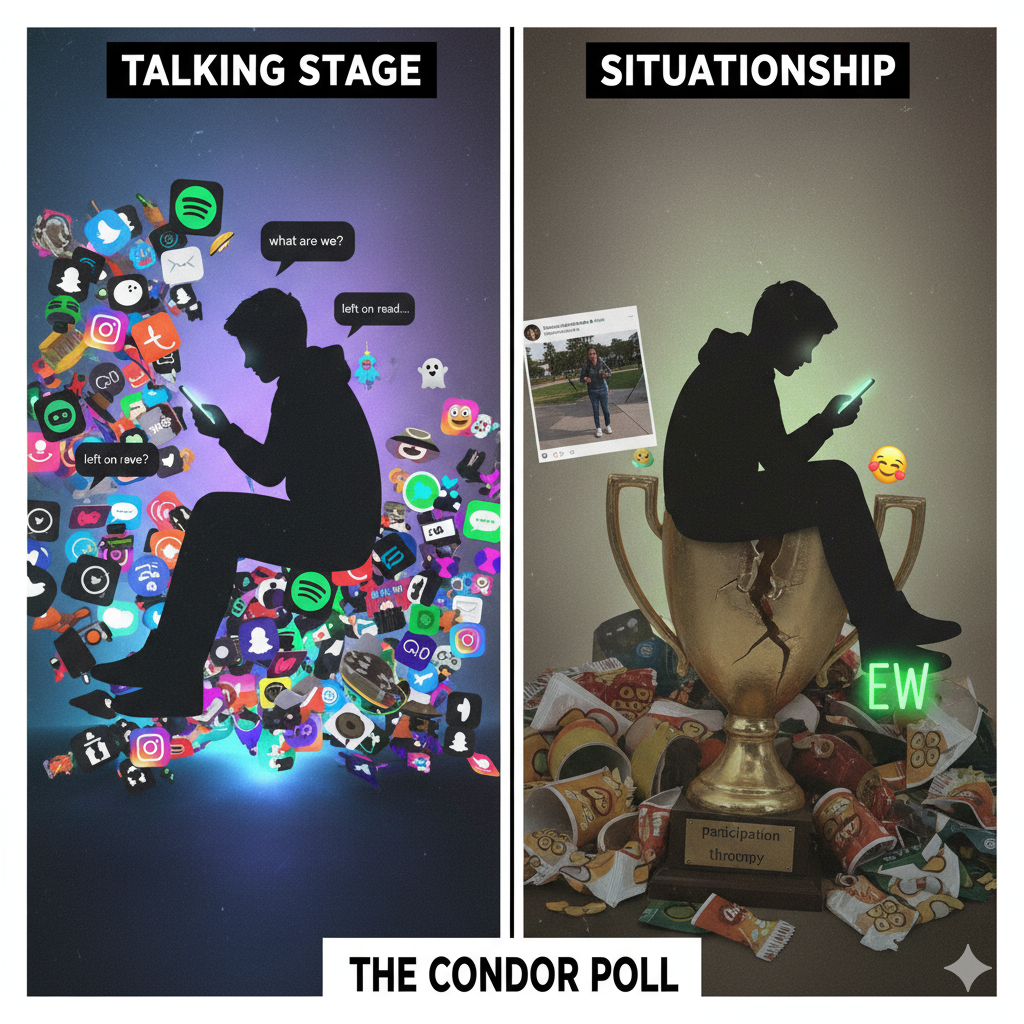
A situationship is defined as “a romantic or sexual relationship that is not considered to be formal or established,” but by Cal High students, it’s defined as “Ew.” Amidst high school social blunders, situationships sit somewhere between tripping in the large quad and accidentally liking someone’s three-year-old Instagram post. It is the “participation trophy” of romance—all the effort of a relationship with none of the security. If our poll results are any indication, teens are ready to trade in the “it’s complicated” status for something a little more substantial.
The distaste isn’t just about the lack of a label; it’s about the mental gymnastics. In a recent poll of 93 Cal High students, 52% voted “Ew,” 41% chose “Good starting point,” and a tiny 7% selected “Better than the real thing.” Between the anxiety of being left on read and the ambiguity of what “we” actually means, students are finding that these undefined gray areas are more exhausting than a final exam.
Not everyone feels the stress of the undefined, however. “I personally find it fun to have something on the side rather than a full commitment. It’s a lot of responsibility to maintain a relationship, and it just isn’t the time for me personally,” wrote senior Ian Garcia Camarena. While Ian’s perspective highlights the benefit of low-stakes fun, it also touches on a growing trend: commitment phobia. For many, a label feels like a contract they aren’t ready to sign. By keeping things in the “talking stage,” students create a safety net; if things go south, they can claim it “wasn’t that serious” anyway. However, this safety net often turns into a trap of mixed signals and late-night overthinking.
Of course, before the situationship comes its equally vague cousin: the talking stage. It’s a period where you’re more than friends but less than a couple—a digital purgatory defined by Snapstreaks and curated Spotify playlists. Junior Diego Estrada shared, “I think that a talking stage is a good start because it’s a great way to get to know if that person is someone you would like to date.”
The average student spends three to five weeks in this limbo before either upgrading to a “real” relationship or, more commonly, watching it fizzle out into a muted story and a lingering sense of “what if.” Or, as Diego noted from personal experience, they simply end in friendships.
However, the “low-stakes” nature of these stages often comes with a high emotional price tag. When a relationship is never official, the end of it is never a “breakup.” This creates a strange social loophole where students feel they aren’t allowed to be heartbroken over someone they were never technically dating. Sophomore Andrew Ruiz claimed, “It seems like you’re mostly not being honest with each other.”
Andrew’s point about dishonesty hits on a deeper, darker side of the situationship: the gap between physical attraction and actual connection. Often, these non-relationships are fueled by a heat-of-the-moment intensity that lacks a real foundation. While it feels like a rush in the moment, that high is almost always followed by a crash. Without the security students mentioned earlier, the aftermath feels less like a romantic memory and more like a regretful blur. It’s that “gross” post-talking-stage clarity where you realize you gave a lot of yourself to someone who didn’t even have the decency to give you a label.
In this vacuum, it’s easy to mistake a physical spark for a genuine bond. However, when the initial excitement wears off, many students are left with a lingering sense of discomfort. It’s the realization that the situationship was just a placeholder for real intimacy—a temporary fix that leaves you feeling more alone than when you started. It’s like eating junk food when you are starving; it’s great for five minutes, but in the end, it doesn’t fill you at all.
As the 2026 school year barrels toward prom season, the pressure to turn these purgatories into something permanent is rising. While the situationship offers a convenient exit ramp for those wary of commitment, the consensus among the student body remains clear. Whether it’s the fear of being left on read or the exhaustion of interpreting the meaning behind a specific emoji, the gray area is losing its luster.
Perhaps it’s time to retire the situationship. After all, if a relationship feels like a full-time job without a contract, it might be time to quit. In the end, the “Ew” factor isn’t just a trend—it’s a collective call for something a little more real and a lot less complicated.