










“Trust yourself.” “Don’t be afraid to be human.” “Be gold.”
These are the mantras of the women leading Cal High. While their roles range from the principal’s office to the chemistry lab, their mission is identical: showing students that there isn’t just one way to be a leader. Often, we see these women as finished products—successful and in control—but behind every office door is a story of “stumbling” toward the “right next step.”
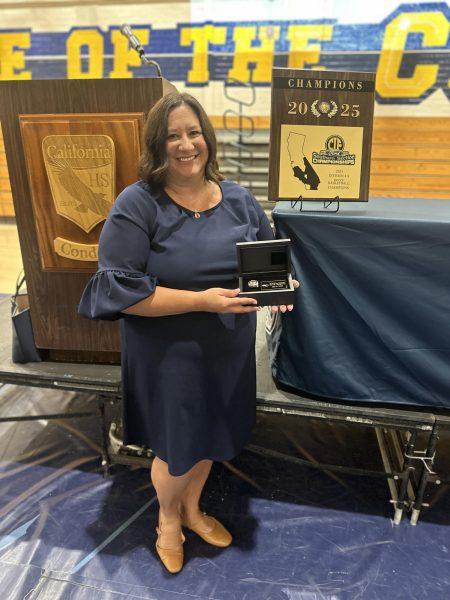
In the principal’s office, you might expect to find someone who spent their life dreaming of the “big chair.” For Mrs. Shana Jones, however, the path was organic. “I didn’t start teaching with the anticipation of becoming an administrator,” she shared. Instead, her journey was a ten-year evolution from the classroom to leadership roles fueled by a simple love for teaching and working collaboratively with others.
For Jones, leadership is about perspective. While many organizations struggle with gender parity, Jones notes that Cal High’s administration has maintained a near 50/50 balance for the decade she’s been here. To her, this isn’t just a statistic—it’s a strategy. “It has benefited our school to have a multi-lens approach,” Jones explained. By maintaining a diverse team, the school avoids a “single-sided view,” ensuring leadership reflects the student body they serve.
While Jones leads through a school-wide lens, English teacher Mrs. Franny Padgett finds her impact through the power of a story. Like Jones, Padgett’s career “got dropped in her lap” when an opening appeared at her mother’s school. What began as a sudden career move turned into a lifelong passion for the “magic of literature.”
Padgett finds inspiration in “feisty female characters” who challenge the status quo with intelligence. She carries this energy into her classroom, pushing students to look beyond the “one right answer.” In a world of high-stakes testing and social media perfectionism, she advocates for the beauty of the “rough draft”—not just in essays, but in life.
“Failure is a very important part of life,” Padgett noted, observing that many students are now terrified of being seen as “imperfect.” To her, a strong woman’s story isn’t a straight line; it is a book made of three vital chapters: finding comfort, stumbling, and learning to walk.
For women in STEM, the “stumbling” phase can feel particularly daunting. Chemistry teacher Mrs. Jessica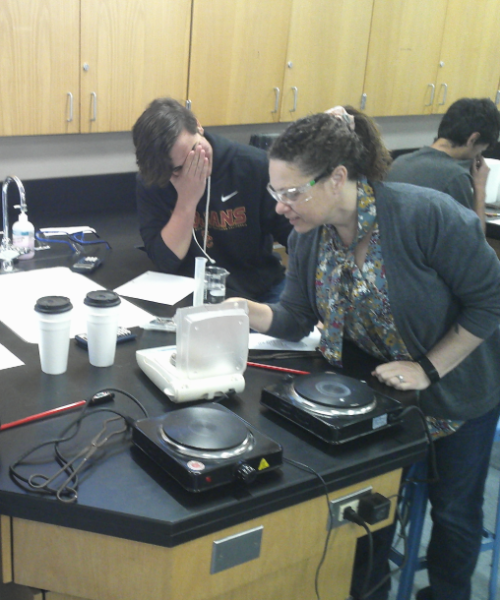 Clendenon has turned the act of making mistakes into a scientific art form. Unlike those who felt “called” to teach, Clendenon’s journey was fueled by defiance. Raised in an environment where her value was seen primarily as a future “wife and mother,” she fought for her seat at the lab bench. “I became who I am by saying, ‘Yes, I am,’ and fighting against what everybody said I should be,” she shared.
Now, she uses her platform to dismantle the barriers she once faced. Whether navigating dyslexia or fighting “Imposter Syndrome,” Clendenon models her own mistakes for her students. By showing that even the teacher can get it wrong, she creates a space where students feel brave enough to take risks. To Clendenon, a strong woman is defined by three specific elements: Helium: Independent and bright. Gold: Resilient; no matter how much life “pounds” you, you
remain gold. Tungsten: The ability to remain strong under pressure even when outside forces try to bring you down.
Though their daily tasks look vastly different—managing a campus, analyzing metaphors, or balancing equations—these women share a singular vision. They are living proof that leadership doesn’t have a “standard” look or a mistake-free path.
As Mrs. Padgett puts it, the goal is for every student to “find your way to be loud and bold” in a way that is unique to them. Whether that means leading through a “multi-lens” approach or remaining “non-reactive” like gold, the message is clear: the most important experiment you’ll ever run is the one where you discover who you are.
Izaac • Mar 6, 2026 at 3:26 pm
This is so peak this must have took an insane amount of interview time